Pages

Thursday, November 5, 2020

Gearknob Project


Gearknob project

At the start of the year, I began the Gearknob project at Tauranga Boys College. Due to unfortunate circumstances, I was unable to complete the project there and moved down to Christchurch and started studying at Hornby High School. At my new school, I began the Gearknob project again and finally completed it. the project is made entirely out of aluminium and would require precision when marking out and cutting. 

To be perfectly honest, I didn't think that I would have been able to finish the project due to a short amount of time. The Gearknob is missing the top plate that I couldn't finish off since I didn't have much time so I did the best with what I had. 


Dimensional Measuring Equipment


Dimensional Measuring Equipment 

 Selecting, using, and caring  for engineering dimensional measuring equipment 

 US 4435 v8  Level 2 Credits 3 

Ayman Dean


People credited with this unit standard are able to – select; use, and care for engineering dimensional measuring equipment. 


Examples of engineering dimensional measuring equipment are – vernier callipers; internal, external, and depth micrometres; dial test indicator (DTI); height gauges; steel rules.


To pass this assessment I need to provide evidence that I can select the correct equipment in accordance with the geometry of the object to be measured, likely magnitude of dimensions, and required accuracy. 

I also need to show that I can carry out equipment checks before use and any faults are reported, examples are – deformation, breakages, stickiness, not zeroing, missing parts, expired calibration. 


My evidence to support my assessment booklet will need to show a micrometre; vernier callipers; and two other items of dimensional measuring equipment from the list above.


My evidence of using Dimensional measuring equipment.

Please include  evidence of you using the dimensional measuring equipment

Vernier Caliper

What are you measuring?

A piece of 25mmx25mm square bar

What is the accuracy and range of the device?

Accuracy is 0.1mm and range is 0-150mm


What was the dimension you recorded?

25.1mm


How did you check it?

By measuring the same 25mmx25mm square bar with all of the measurings tools


Micrometre

What are you measuring?

A piece of 25mmx25mm square bar


What is the accuracy and range of the device?

Accuracy is 0.01mm and range is 0-25mm


What was the dimension you recorded?

25.1mm


How did you check it?

By measuring the same 25mmx25mm square bar with all of the measurings tools


Vernier Height Gauge 

What are you measuring?

A length of 25x25mm square bar


What is the accuracy and range of the device?

Accuracy is 0.1mm and range is 0-30cm


What was the dimension you recorded?

25.1mm


How did you check it?

By measuring the same length of 25x25mm bar with another measuring tool


Steel Rule 

What are you measuring?

25x25mm Square bar


What is the accuracy and range of the device?

Accuracy is +/- 0.5mm and range is 0-300mm


What was the dimension you recorded?

25.1mm


How did you check it?

By measuring the same length of 25x25mm bar with another measuring tool


What have I learnt?

How to correctly and effectively use a wide range of measuring equipment in my work.


What was the most difficult tool to use and why?

The micrometre was a bit difficult to use because I haven't used it before 

What did I enjoy?

Using the height gauge to mark out aluminium.

What would I do differently next time?

Use a micrometre more because it gives more accurate measurements.


This supports the assessment for dimensional measuring equipment  that can be found on this website https://sites.google.com/hornby.school.nz/mr-r-manufacturing/senior-manufactring/dimensional-measuring-tools?authuser=0

Wednesday, October 14, 2020

How to work out if the network is traversable

The Konigsberg Bridge Problem 

The seven bridges of Konigsberg is a historical mathematic problem. It's negative resolution by world-famous mathematician Leonhard Euler in 1736 laid the foundation for graph theory. 

The problem was that could you travel across all seven bridges of Konigsberg without going through the same bridge twice.

Leonhard Euler 


Leonhard Euler was a Swiss mathematician, physicist, astronomer, geographer, logician, and engineer who made important and influential discoveries in many branches of mathematics. He is the one who figured out the Konigsberg theory. 


How to figure out if a network is traversable 

Networks are only traversable if the nodes are all even. 
If a network has two odd nodes it will still be traversable but it has to start at an odd node and finish at an odd node as well.  
If a network has more than two odd nodes it will not be transferable. 
Below are examples of traversable and non-traversable networks 


To figure out if a node is odd or even all you have to do is count the number of lines going into a certain node. 

For example; node A has 2 lines going into it. 2 is an even number so this node is even. Node B has 3 lines going into it and 3 is an odd number so this is an odd node. 


Before reading this did you ever hear about Leonhard Euler?

Wednesday, August 26, 2020

Basic Shapes and Terminology in Mathematics

 Maths Facts 

There are many facts in the world of mathematics and some can be quite confusing, to say the least. Here are some that can be helpful for year 12 students. 

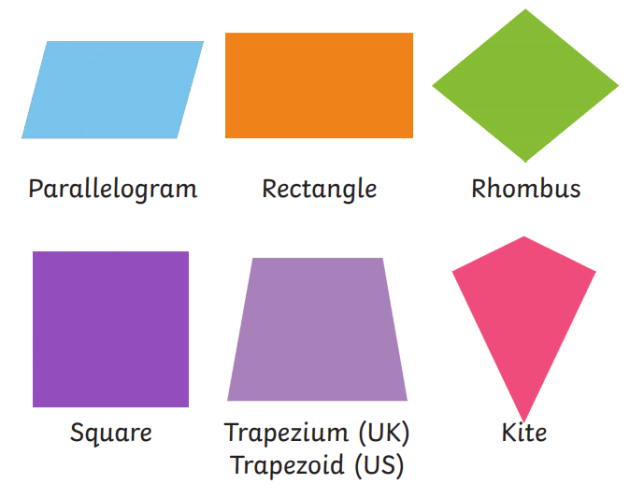
Quadrilateral shape - A quadrilateral is a shape that has four sides. Even if a shape has all four sides and two of those may not be equal it is still considered a quadrilateral shape. the interior angles of a quadrilateral will always equal to 90 degrees no matter the length.
What is a Quadrilateral? - Answered - Twinkl Teaching Wiki

Shapes - Square 

  • A square is a quadrilateral shape. A quadrilateral is a shape that has four sides.
  • All four sides of a square are equal.
  • All of the angles of a square are 90 degrees.

Rectangle 

  • A rectangle has four sides but unlike the square only the opposite sides are equal. 
  • All of the interior angles of a rectangle are 90 degrees.
Rhombus
  • A rhombus is a flat shape that has four equal sides.
  • The rhombus looks like a diamond.
  • All sides are equal in length.
  • Opposite sides are parallel but opposite angles are equal.
  • Every square you see is a rhombus but not every rhombus will be a square.
Parallelogram
  • A parallelogram is a quadrilateral that's opposite sides are equal.
  • Its opposite angles are equal as well. 
  • only two sides are equal. 
Trapezium 
  • A trapezium has a pair of parallel sides 
  • Only two sides of a trapezium are equal in length 
  • A trapezium becomes an isosceles trapezium when it has equal angles from a parallel side. 
Kite 
  • has two pairs of sides 
  • each pair is two equal-length sides that are adjacent 
  • the angles are equal when the two pairs meet

Triangles - Are shapes that have three sides and angles. The interior angles for triangles add up to 180 degrees. In total there are different types of triangles; equilateral, right-angled, isosceles, obtuse, scalene, and acute triangles. 

Types of Triangles & Their Properties - Video & Lesson Transcript |  Study.com

Equilateral triangles
  • All of the sides of an equilateral triangle are equal. 
  • All of the angles in an equilateral triangle are equal and are always 60 degrees
Right-angled triangles 
  • One angle will always be 90 degrees
  • Most of the time will have two equal sides,
Isosceles triangle 
  • Will always have two equal sides 
  • Will always have two equal angles
Obtuse triangle 
  • Will always have an angle of more than 90 degrees
Acute Triangles 
  • All angles will always be less than 90 degrees
Scalene Triangles
  • A scalene triangle doesn't have any equal sides nor angles 
Do you know any other four-sided shape?


Most of the information was found at https://www.mathsisfun.com/geometry/kite.html


Thursday, August 20, 2020

2020 Engineering

Gear Knob Project


Hi, my name is Ayman. I'm a transfer student from Tauranga Boys College. this is my second week at Hornby High School.  currently, I am working on the gear knob project. more specifically I'm working on the small discs that go in between the metal plates. back in my old school, I had started the project in term 1. unfortunately I couldn't complete the project before I moved and I couldn't bring it with me as well. I have emailed my previous engineering teacher to mail me my project so I can finish off the project and gain the credits. currently, I don't have any pictures to share so I'll finish off the project then share the pictures. 

THIS BLOG POST WILL BE UPDATED IN THE FUTURE